Western Roman Empire - online puzzles
Online puzzle Western Roman Empire
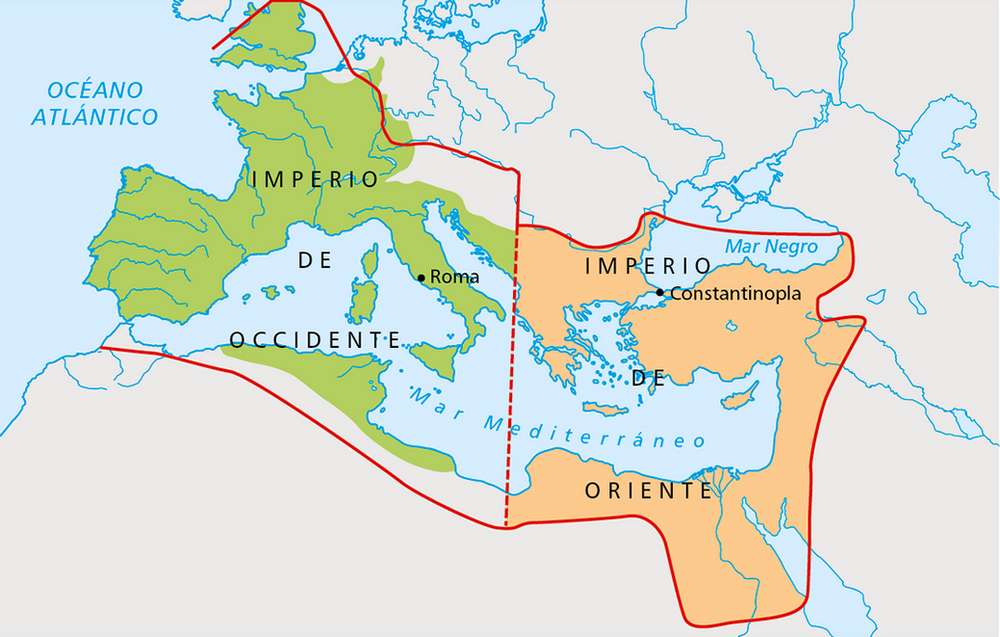
In historiography, the Western Roman Empire refers to the western provinces of the Roman Empire at any time during which they were administered by a separate independent Imperial court; in particular, this term is used to describe the period from 395 to 476, where there were separate coequal courts dividing the governance of the empire in the Western and the Eastern provinces, with a distinct imperial succession in the separate courts. The terms Western Roman Empire and Eastern Roman Empire were coined in modern times to describe political entities that were de facto independent; contemporary Romans did not consider the Empire to have been split into two separate empires but viewed it as a single polity governed by two separate imperial courts as an administrative expediency. The Western Roman Empire collapsed in 476, and the Western imperial court in Ravenna was formally dissolved by Justinian in 554. The Eastern imperial court survived until 1453.
Though the Empire had seen periods with more than one Emperor ruling jointly before, the view that it was impossible for a single emperor to govern the entire Empire was institutionalised to reforms to Roman law by emperor Diocletian following the disastrous civil wars and disintegrations of the Crisis of the Third Century. He introduced the system of the tetrarchy in 286, with two separate senior emperors titled Augustus, one in the East and one in the West, each with an appointed Caesar (junior emperor and designated successor). Though the tetrarchic system would collapse in a matter of years, the East–West administrative division would endure in one form or another over the coming centuries. As such, the Western Roman Empire would exist intermittently in several periods between the 3rd and 5th centuries. Some emperors, such as Constantine I and Theodosius I, governed as the sole Augustus across the Roman Empire. On the death of Theodosius I in 395, he divided the empire between his two sons, with Honorius as his successor in the West, governing from Mediolanum, and Arcadius as his successor in the East, governing from Constantinople.